
In the world of modern football, fans are often deceived by the glamour of tactics and individual skills on the green pitch, ignoring the real battle taking place behind the scenes: the battle of supply chains, distance management, and logistical auditing. What we witnessed in the knockout stages of the 2026 World Cup was not merely a football clash; it was a live case study proving that operational superiority closes the "confrontation budget" before the referee even blows the starting whistle. By merging geographical distances with technical performance, the language of numbers reveals how certain entities collapsed, and how others survived through pure administrative brilliance.
🗺️ The Operational Ledger: Full Trajectories and Asset Liquidation
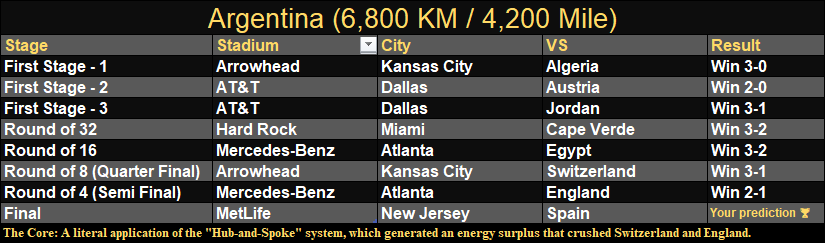
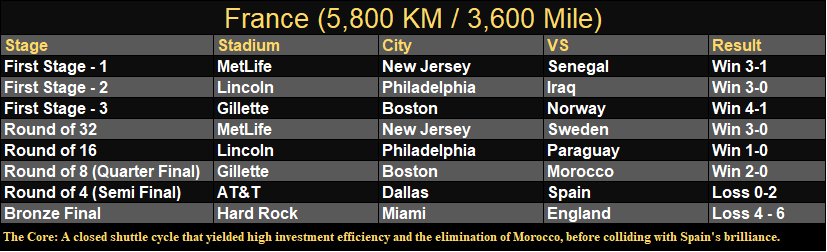
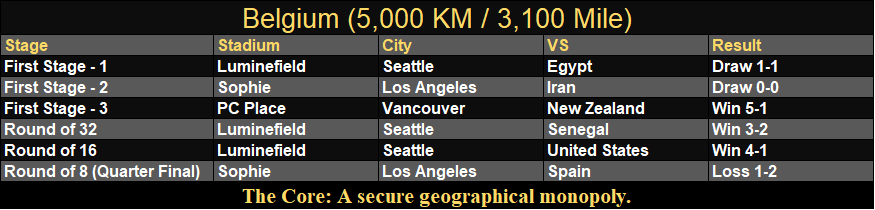
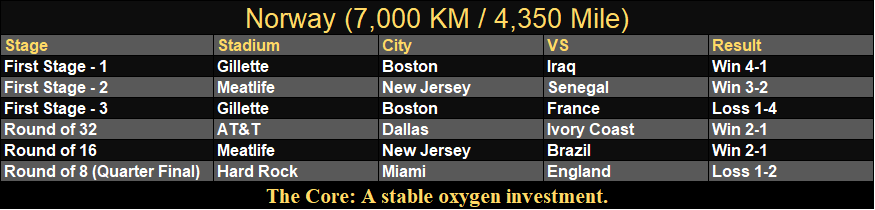
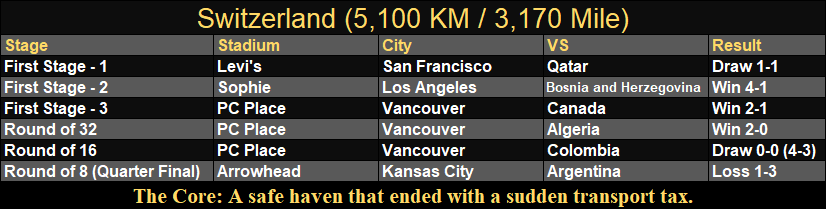
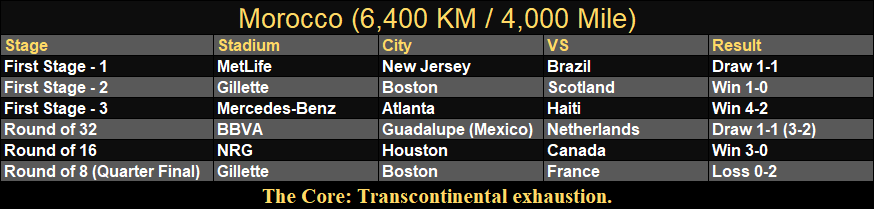
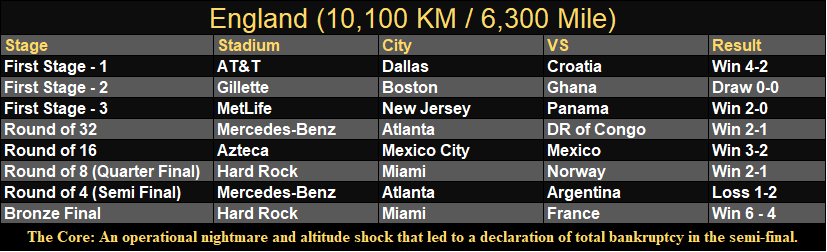
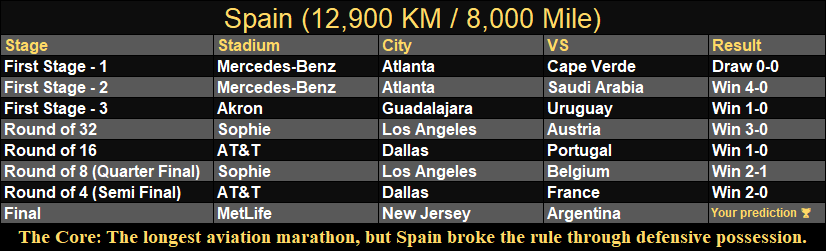
Here is the comprehensive logistical survey (in miles and kilometers) for all the stops of the eight teams, and how geography impacted their physical liquidity:
The Stable Entities (Logistical Winners)
The Depleted Entities (Logistical Losers)
📉 The Operational Ledger: Decoding the Quarter-Finals (The Bottleneck) and Semi-Finals (The Clearing of Accounts), and Operations Analysis. How did distances translate into numbers?
France (2) - Morocco (0): The Battle of Monopoly and Penetration (Maximizing ROI) - First Quarter-Final
The "Dominant Institutional Entity" collided with the fiercest emerging market. France navigated a closed shuttle cycle with a route of barely 1,600 km, while Morocco underwent a transcontinental geographical stress test exceeding 6,400 km.
The language of numbers reveals French operational intelligence; they allowed Morocco a phantom possession (51% with 524 passes), letting their exhausted players run in non-dangerous zones. The result? Total Moroccan bankruptcy with an expected goals (xG) of only 0.12 and a single shot on target. In contrast, France executed a "Return on Investment (ROI) Maximization" strategy; lower possession (49%) but with devastating efficiency that produced 22 shots and a 2.95 threat rate, securing qualification with the lowest physical cost.
The Core: France leveraged its stability to freeze the penetrations of an exhausted Morocco, achieving an offensive yield of (2.95).
Spain (2) - Belgium (1): Defensive Possession and Risk Management - Second Quarter-Final
Spain entered suffering from "geographical concussion" and terrifying depletion (+8,200 km), facing a Belgian entity that monopolized rest (~3,100 km). How did the exhausted entity win? Through "Defensive Possession." The Spanish monopolized the ball (68% and 665 passes) as a mechanism to protect assets from depreciation. The numbers expose the Spanish fatigue through lost aerial duels (8 for Belgium vs. 4 for Spain), and registering (zero) counterattacks to save stamina. This possession "froze" the well-rested Belgian assets, sending them home with a disastrous net threat of only 0.35.
The Core: Spain, despite its terrifying route, survived Belgium by monopolizing the ball (68%) to rest its players' feet.
England (2) - Norway (1): The Poisoned Victory and Supply Failure - Third Quarter-Final
Norway entered with a safe investment (7,000 km), while England arrived with severe depletion (8,100 km) and altitude shock in Mexico. This win was a "poisoned victory" for the English; mental fatigue manifested in the collapse of their passing system, falling into the offside trap 5 times. England lost "operational flexibility," settling for a single counterattack, and was forced into 32 clearances to survive a defensive chaos with a modest threat yield (1.14). This effort was a heavy debt they would pay later.
The Core: England paid the Mexico bill with a poisoned victory over Norway through 32 defensive clearances and total randomness.
Argentina (3) - Switzerland (1): Return on Stability and System Collapse - Fourth Quarter-Final
Switzerland jumped from its cold safe haven to Kansas to pay a heavy transport tax (5,100 km), against an Argentina fortified by a Hub-and-Spoke positioning system at 4,600 km. Geographic stability translated into terrifying productivity; Argentina possessed the ball (59%) and produced 22 shots with an xG of 2.13. The physical surplus allowed them to win duels (15 successful) and launch 4 counterattacks. Meanwhile, Switzerland lived through "random crisis management" with 32 clearances, ending in a "total organizational collapse" translated into a red card caused by mental fatigue.
The Core: Argentina crushed Switzerland thanks to the stability of Kansas, leading to the collapse of the Swiss system and a red card..
France (0) - Spain (2): Preventive Maintenance (Operational Anomaly) - First Semi-Final
In the semi-finals, the illusion of geography fell! An exhausted Spain at 10,800 km ousted a stable France at 4,000 km. How? Through "Preventive Maintenance." The Spanish did not run to recover the ball; instead, they executed (16) proactive interceptions compared to France's 6; mind preceded muscle! Offensively, they achieved the "Maximum Yield": only two shots on target = two goals. They paralyzed the French physical surplus, forcing them out with an xG of 0.44.
The Core: The illusion of geography fell in favor of intellect; a heavily exhausted Spain ousted a stable France thanks to (16 proactive interceptions), achieving stunning "preventive maintenance."
England (1) - Argentina (2): (Declaration of Total Bankruptcy) - Second Semi-Final
Here, the rule was applied to the letter. An exhausted England at 9,200 km declared physical bankruptcy against a stable Argentina at 5,600 km. England's liquidity shrank to (37% possession) and supply lines completely halted (0 counterattacks, 5 shots). In contrast, Argentina monopolized operations (590 passes, 14 shots) and brought down the desperate English defense in the (85th and 92nd) minutes when the English stamina tank was completely empty.
The Core: An exhausted England declared total bankruptcy (37% possession and 0 counterattacks) falling victim to Argentina's energy surplus..
⚔ The Final Battles: Who Will Pay the Final Bill?
The Bronze Medal (France vs. England): The Bankruptcy Gamble and Comprehensive Asset Liquidation!
Logistical data favored the geographically stable French entity (5,800 km) against its English counterpart, which was logistically crushed with a distance exceeding 10,100 km. However, what happened on the pitch at "Hard Rock" was a rare case of "High-Risk Speculation"; instead of surrendering to physical collapse, England chose an "all-or-nothing" gamble, forcing the match into organizational chaos and mutual "offensive asset liquidation" that ended with a historic scoreline (6-4). The language of numbers exposes this operational glitch:
Defensive Crisis Management: An exhausted England was forced into a terrifying number of random clearances (29 English clearances vs. 16 for France) simply to repel danger and stay alive.
Maximizing Offensive Yield: Despite similar possession and shots (20 for France, 19 for England), the English achieved a higher threat rate (3.19 vs. 2.69) thanks to direct, reckless penetrations that miraculously succeeded. England snatched the bronze via a "suicidal speculative deal," abandoning any defensive organization, while France paid the price for operational complacency and failed to leverage its physical liquidity!
The Dream Final (Spain vs. Argentina): The Fall of the Geographic Illusion!
Argentina reaches the final through a brilliant and comfortable operational route not exceeding (6,800 km / 4,200 miles), while Spain crawls toward MetLife with a terrifyingly depleting route nearing 12,900 km. Logistically: Argentina is the favorite. Realistically and Technically: Spain is the awaited champion. Why? Because Spain possesses impenetrable "defensive assets," conceding only a single goal throughout the tournament. Spain proved that possession and tight organization break the fatigue barrier. In contrast, Argentina's physical surplus wasn't solely born out of geography but was built on "external facilities" and controversial refereeing decisions clearly evident from the group stages to the elimination of Egypt. In the final, this external support will shatter against the rock of the "Spanish Entity," which is administratively and technically fortified.
🌍 The 2030 World Cup Shock: Transoceanic Bureaucracy
According to official documents issued by the FIFA Council, the 2030 World Cup will not be just a tournament; it will be the "most complex logistical and bureaucratic nightmare in the history of sports." True, distances between the primary host nations (Morocco, Spain, Portugal) are very short, not exceeding a two-hour flight. However, the real complexity lies in the "Unique Centenary Event." Forcing teams to play their opening matches in South America (Uruguay, Argentina, Paraguay) during the southern winter, followed by immediate transoceanic flights to switch continents, and judicial and customs systems, to play the remainder of the tournament in the northern summer of Europe and Africa, is an unprecedented challenge in global supply chain management. FIFA was forced to adjust the calendar and grant a 12-day window for travel and acclimatization, proving that the champion of 2030 will not be the one with the best stars, but the entity possessing the strongest "customs clearance, international relations, and physiological acclimatization" team.
💡 The Maven’s Message:
Sports are exactly like major corporate entities.
Governed by operational efficiency, optimal resource utilization, and strict logistical auditing. The mindset that deconstructs the most complex tournaments and predicts their paths based on operational data is the very same mindset that builds sustainable projects and entities.
The roadmap may be forced upon you, but you draw your own map of survival!
In the sports world, no entity can choose its geographical path or volatile market conditions, but it has the absolute power to manage its assets for rapid recovery and adaptation. Just as Spain did when they transformed possession and passing from a mere game plan into a "preventive maintenance tool" to protect their assets from logistical depreciation.
Primecore Maven (ضليع الجوهر):
Every global event carries behind the scenes a profound administrative case study, much like the policies, economies, and cultures of nations.
Transforming passion for major events into strategic awareness inspires professionals to apply this operational precision in their own paths.
If you are fascinated by reading behind the scenes and decoding success with an investment and resource-management mindset, you are already part of this entity.